


Proven Automation Ready for Australian Manufacturers
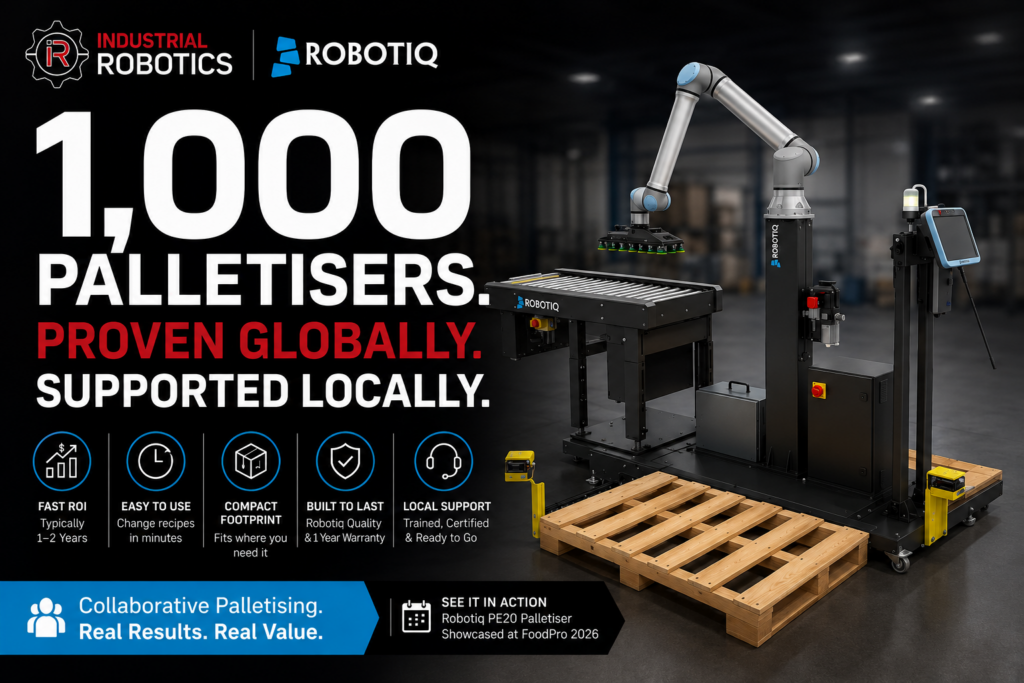
Robotiq has officially reached a major global milestone.. its 1,000th palletising workcell installation.
For Australian manufacturers considering end-of-line automation, that number matters. It means collaborative palletising has moved well beyond being an emerging technology. Robotiq has now accumulated experience from 1k real-world palletising deployments, helping manufacturers automate one of the most repetitive, physically demanding and difficult-to-staff jobs on the production floor. Our team at Industrial Robotics are trained, certified, and ready to help Australian businesses put this proven technology to work locally.
Register for the Automation Talk on August 27, 2026 10:00am (ET)
https://palletizing.robotiq.com/robotiqs-1000th-pal
Register for the Safetics Talk on September 03, 2026 4:00pm (AEST)
https://www.safetics.io/en-US/seminar/webinar260903_en-content
We Put It to Work at FoodPro 2026
Visitors to FoodPro 2026 in Melbourne had the opportunity to see the Robotiq PE20 operating live on our stand. Rather than simply talking about automation, we wanted manufacturers to see how straightforward modern collaborative palletising has become.
The PE20 demonstrated exactly why this technology is attracting attention from food and beverage manufacturers and other high-volume producers: compact equipment, straightforward operation, rapid product changeovers and industrial-scale palletising without the complexity traditionally associated with robotic cells.
Now, with Robotiq celebrating its 1,000th palletising deployment, Australian businesses can access that same globally proven technology with local integration, training, and support through Industrial Robotics.
Why Automate Palletising?
Palletising is necessary. Having a person repeatedly lift and stack cartons for an entire shift isn’t. Manual palletising consumes labour that could be used elsewhere in the business and exposes workers to repetitive lifting, bending, twisting, and fatigue. Automation changes the equation. A Robotiq palletising workcell can provide:
- Reduced reliance on manual palletising labour
- More consistent production and throughput
- Reduced repetitive manual handling
- Consistent pallet patterns and stacking
- Greater ability to respond to labour shortages
- Predictable production across shifts
- Fast changeovers between products and pallet configurations
- The ability to redeploy employees into higher-value work
Robotiq’s current palletising platform can support payloads of up to 35 kg depending on configuration, with throughput of up to 13 cycles per minute, and an unlimited number of SKUs and pallet patterns. Plus the system can stack pallets up to approximately 2.15 metres high depending on your product / pallet configuration.
The Business Case: Where the Savings Come From
The attraction isn’t simply that a robot can stack boxes. It’s what happens to your operating costs once it does.
Consider a palletising position that needs to be staffed throughout production. The real annual cost isn’t simply the employee’s base hourly rate. Businesses also carry superannuation, leave, workers compensation, recruitment, training, overtime, supervision, plus the operational impact of absenteeism and staff turnover.
If production operates across multiple shifts, that cost multiplies. A palletiser is therefore best assessed against the total cost of performing the process manually, together with the productivity the automated system can unlock. Robotiq identifies savings from labour, downtime, and productivity improvements as important parts of the ROI calculation.
Importantly, automation doesn’t necessarily mean reducing headcount. For many manufacturers, the bigger opportunity is using our people more effectively. Instead of spending hours manually stacking cartons, an operator can be reassigned to production, quality, machine operation, maintenance, logistics, or another task that actually benefits from human judgement and skill.
How Fast Can It Pay for Itself?
This is where palletising automation gets particularly interesting.
Robotiq currently advises that most factories can achieve an ROI in approximately one to two years, with some applications achieving payback from around 12 months. And these aren’t simply theoretical spreadsheet calculations. Robotiq reports a 13-month payback for Glenhaven Foods, while bakery manufacturer Hack AG expects its Robotiq system to achieve payback in approximately 14 to 16 months.
Every Australian factory is different, of course. Your return will depend on factors including:
Current labour cost + number of shifts + production volume + throughput + available labour + product mix + downtime + the selected palletising configuration.
That’s why Industrial Robotics can assess the actual application rather than applying a generic ROI figure.
The question isn’t simply: “How much does a robot cost?”
The better question is: “How much is manual palletising currently costing our business every year?”
You Don’t Need a Robotics Programmer to Run It
One of the biggest differences between today’s Robotiq palletising systems and traditional robotic automation is usability. Robotiq specifically designed its palletising software so everyday operators don’t need robotics programming experience.
New palletising recipes /SKU can be created in minutes. That becomes extremely valuable for Australian manufacturers handling multiple carton sizes, seasonal products or frequent packaging changes. Your production team isn’t calling a robotics engineer every time a carton changes. Operators can select recipes and start production through straightforward controls, while the software handles much of the underlying robotic complexity. And if the palletiser enters a protective stop, Robotiq’s software provides guided recovery functionality designed to help production resume quickly rather than requiring specialist intervention for every stoppage.
Built Around Real Factory Floors
Not every Australian factory was designed with robotics in mind. Space is tight. Conveyors are already installed. Production can’t simply stop for weeks while an automation project is commissioned. That’s precisely where standardised collaborative palletising becomes attractive.
Robotiq states that its palletising workcells can have a footprint three to four times smaller than traditional robotic palletising solutions, while its standard systems are designed for deployment in days rather than lengthy custom integration projects. For manufacturers, that means automation can potentially be introduced at the end of an existing line without rebuilding the entire production process around the robot.
The automation fits the factory, rather than forcing the factory to fit the automation.
What About Warranty and Support?
A robotic system is a production asset, so support after installation matters just as much as the initial deployment.
Robotiq’s warranty for its palletising solution covers the solution and its components against defects in material and workmanship for one year from receipt when used as intended and in accordance with the specified operating, installation and maintenance conditions. Warranty conditions can vary between products and configurations, so Industrial Robotics will confirm the applicable warranty as part of each project proposal.
Just as importantly, Australian customers aren’t expected to work through an overseas automation project alone.
Industrial Robotics provides local consultation, integration, commissioning, testing, training, servicing and ongoing technical support. We want the technology to keep delivering after commissioning day.
1,000 Deployments Means 1,000 Lessons Learned
Perhaps the biggest advantage of Robotiq reaching 1,000 palletising deployments isn’t the number itself. It’s the experience behind it. Every installation adds knowledge about boxes, pallets, layouts, throughput, changeovers, operators, production environments and the practical realities of getting automation onto a working factory floor.
For an SME manufacturer, that significantly changes the risk profile. You aren’t asking someone to invent a palletising system from scratch. You’re starting with a standardised, proven automation platform backed by more than 1,000 deployments worldwide and a local team trained and ready to put it to work.
Could Palletising Automation Work in Your Factory?
If you saw the Robotiq PE20 at FoodPro 2026, now is the time to continue the conversation. And if you didn’t make it to FoodPro, we’ll bring the conversation to you. Industrial Robotics can assess your existing palletising process, product sizes, pallet configurations, throughput and labour requirements and help determine:
Is it technically feasible?
What system would you need?
How much could it save?
Let’s Calculate Your Palletising ROI
Talk to Industrial Robotics about a palletising assessment, demonstration or ROI calculation for your production line.
Bring us your cartons, production volumes, and current palletising process. We’ll help you work out whether automation stacks up for your business.
1300 4 ROBOTS (1300 476 268)
sales@industrial-robotics.com.au
Ready to stop stacking boxes and start stacking the numbers in your favour?
Contact Industrial Robotics today.