


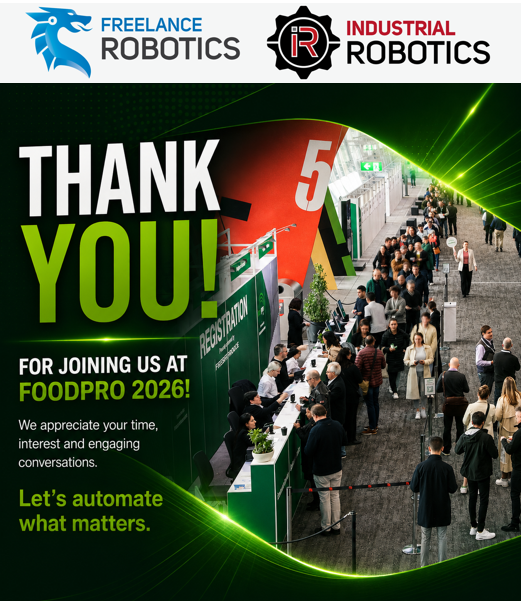
FoodPro 2026 Highlights the Growing Momentum Behind Food Automation
How palletising and intelligent pick-and-place robotics are helping Aussie and NZ food manufacturers stay competitive.
FoodPro once again demonstrated why automation has become a strategic priority for food and beverage manufacturers. Across the exhibition floor, one message was clear: businesses are no longer asking if they should automate, they’re asking where to start.
Industrial Robotics was proud to partner with Freelance Robotics and showcase practical robotic solutions designed specifically for food production environments. Throughout the event, visitors experienced first-hand how collaborative robotics and intelligent automation can solve many of the industry’s most pressing challenges thanks to live demonstrations with Robotiq, OMRON, Universal Robots, and Lyro.
Rising costs and labour shortages continue to drive automation
Food manufacturers throughout Australia and New Zealand continue to face increasing pressure from rising labour costs, skills shortages, growing production demands, and stricter quality expectations. Many businesses are also looking for greater flexibility as product ranges expand and consumer preferences continue to evolve.
Automation is proving to be one of the most effective ways to address these challenges while maintaining competitiveness.
Unlike traditional industrial automation, today’s collaborative robotic systems are more accessible than ever. They can often be deployed without major changes to existing production lines, making automation achievable for businesses of all sizes.
Palletising remains one of the fastest wins
One of the standout technologies at FoodPro 2026 was collaborative robotic palletising.
Manual palletising is physically demanding, repetitive work that often contributes to workplace injuries and high staff turnover. It can also become a production bottleneck as businesses struggle to recruit and retain workers for these roles. Modern robotic palletising systems offer significant advantages:
- Increased production consistency
- Improved workplace safety
- Reduced manual handling injuries
- Better pallet quality and load stability
- Higher throughput with predictable performance
- The ability to operate continuously across multiple shifts
Flexible collaborative palletisers can also accommodate multiple product sizes and pallet configurations with minimal changeover, making them ideal for manufacturers producing a wide range of products.
Intelligent pick-and-place is transforming food handling
Another area generating considerable interest at FoodPro was robotic pick-and-place automation.
Powered by advanced vision systems and AI-driven software, modern robots are capable of identifying, locating, and handling products that vary in size, orientation, and presentation. This opens new opportunities for automating tasks that were previously considered too complex or inconsistent. Applications include:
- Bakery products
- Fresh produce
- Packaged goods
- Ready meals
- Meat and poultry products
- Confectionery
- Secondary packaging
Intelligent pick-and-place solutions not only increase throughput but also improve product consistency while reducing product damage and waste.
Flexible automation for changing production demands
No doubt, one of the strongest themes this year was flexibility.
Rather than investing in fixed automation designed for a single product, manufacturers are increasingly seeking robotic systems that can adapt to changing production schedules, seasonal demand, and new product introductions.
Collaborative robots, combined with intuitive software and vision technology, enable manufacturers to reconfigure production quickly without lengthy engineering projects. This flexibility allows businesses to respond faster to customer requirements while protecting their investment for the future.
Automation is becoming more accessible
A common misconception is that robotics is only suitable for large-scale manufacturers.
In reality, advances in collaborative robotics have significantly reduced the barriers to adoption. Many systems can be installed with minimal disruption, programmed without specialist robotics expertise, and expanded as production requirements grow.
For many food manufacturers, automation is no longer about replacing people. Allowing existing teams to focus on higher-value work is the critical piece. Robots are there to just perform repetitive, physically demanding tasks safely and consistently.
Looking ahead
FoodPro 2026 reinforced that automation is no longer an emerging trend. Automation is an essential part of building resilient, competitive food manufacturing businesses.
Whether through collaborative palletising, intelligent pick-and-place systems, or flexible end-of-line automation, robotics is helping manufacturers improve productivity, enhance workplace safety, maintain product quality, and address ongoing labour challenges.
As automation technologies continue to evolve, businesses that begin their journey today will be well positioned to meet the demands of tomorrow’s food and beverage industry.
Missed FoodPro? Don’t wait until 2029.
Book a Consultation!
Industrial Robotics designs and delivers advanced automation systems focused on collaborative robotics, intelligent control frameworks, and scalable manufacturing solutions. Working with global technology partners, we help manufacturers transition into high-performance, future-ready production environments.
Whether you are taking the first step or looking to expand, we are here to help you move forward with confidence.
Phone 07 34173473
Click Here! to Contact our Team